
Mont-Saint-Michel FAQ 2026
Every Visitor Question Answered — The Complete Mega-Guide
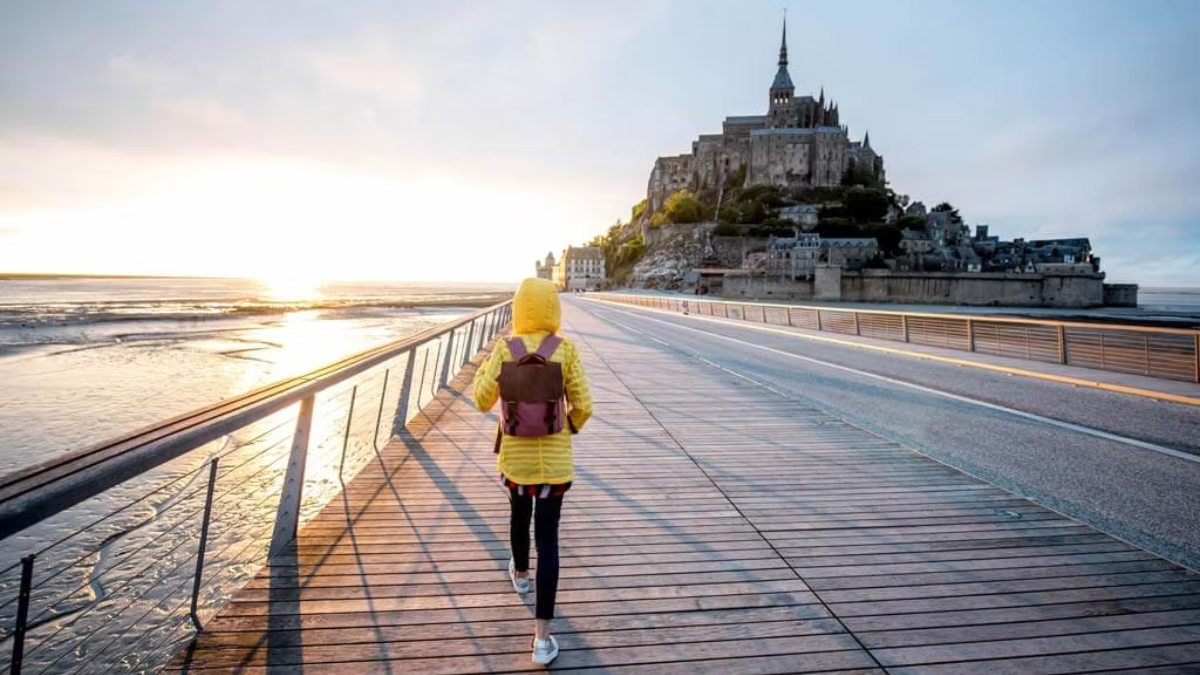
This is the complete FAQ for Mont-Saint-Michel — covering tickets and prices, opening hours, tides, parking, getting there from Paris and beyond, the abbey, the village, the bay walk, staying overnight, accessibility, visiting with kids, and everything else visitors commonly ask. For detailed articles on any topic, follow the links throughout this page.
Essential Information
What is Mont-Saint-Michel?
Mont-Saint-Michel is a tidal island commune in Normandy, northwestern France, topped by a medieval abbey that has been a major pilgrimage destination since the 8th century. The island and its bay were designated a UNESCO World Heritage Site in 1979. It is the second most visited site in France after Paris, receiving over 3 million visitors annually. The island is connected to the mainland by a footbridge built in 2014, replacing an older causeway that had disrupted the bay’s tidal flow for over a century.
Is Mont-Saint-Michel in Normandy or Brittany?
Mont-Saint-Michel is in Normandy — specifically the department of Manche. The Couesnon River, which forms the historical boundary between Normandy and Brittany, passes to the west of the island, placing it firmly on the Norman side. A famous regional saying translates as: “The River Couesnon, in its folly, has placed the Mont in Normandy.”
Is Mont-Saint-Michel worth visiting?
Yes — with the right preparation. The abbey is a masterwork of medieval architecture, the tidal bay is one of the great natural spectacles of France, and the island at dusk or dawn, when the day-trippers have gone, is genuinely extraordinary. Visitors who arrive mid-morning in peak summer with no plan can have a disappointing experience; visitors who arrive early, book the abbey in advance, and allow enough time come away having seen one of the great sites of Europe. See our full is it worth visiting guide.
Can you see Mont-Saint-Michel in a day?
Yes — a well-planned day visit covers the abbey, the ramparts, and the village. Allow a minimum of 4–5 hours on the island. The journey from Paris takes approximately 4–4.5 hours each way, making it a long but feasible day trip. From Rennes, it is around 1h15; from Caen or Bayeux, approximately 1h30–2 hours. See our day trip guide and itineraries.
How many people visit Mont-Saint-Michel each year?
Over 3 million visitors per year, making it France’s second most visited tourist site after Paris. In peak summer, the island receives up to 15,000–20,000 visitors per day.
Tickets and Prices
How much does it cost to visit Mont-Saint-Michel?
The island and village are free to enter — no ticket required. Only the abbey requires a paid ticket. Abbey entry in 2026: €11 for adults. Free for all visitors under 18, EU citizens aged 18–25, disabled visitors and one companion, and jobseekers. The first Sunday of November, December, January, February, and March is free for all. See our full opening hours and prices guide.
Do I need to book the abbey in advance?
Not strictly required, but strongly recommended — particularly from May to September and on spring tide weekends. Walk-up queues at the ticket counter can reach 45–90 minutes in peak season. Booking online through Tiqets costs the same price and lets you go straight to the entrance. See our abbey entry ticket guide.
Is there a combined ticket for the abbey and transport from Paris?
Yes — a ticket combining abbey entry with coach transport from Paris is available through Tiqets. This is the most practical option for visitors without a car making the journey from Paris. See our entry + transport from Paris ticket guide.
Is entry to the island free?
Yes. The village, ramparts, Church of Saint-Pierre, and all exterior areas of the island are freely accessible 24 hours a day with no ticket required. Only the abbey interior requires a paid ticket.
Are there free admission days at the abbey?
Yes — the abbey is free for all visitors on the first Sunday of January, February, March, November, and December. SNCF NOMAD train ticket holders and Brittany Ferries passengers receive a discounted rate of €13 on presentation of their ticket within 5 days of travel. See our opening hours and prices guide.
How much do tours from Paris cost?
Organised day trips from Paris typically range from €80–€150 per person depending on whether abbey entry, a guided tour, and meal are included. See our guided tour from Paris and small-group tour with cider tasting articles for current options and pricing.
Opening Hours and Closures
What are the abbey opening hours?
- May to August: 09:00–19:00 (last admission 18:00)
- September to April: 09:30–18:00 (last admission 17:00)
The abbey is closed on 1 January, 1 May, and 25 December. In 2026 there are also exceptional closures on 23 March and 1 June. See our full opening hours guide.
Is the island open at night?
Yes — the island village is open 24 hours and never closes. The free Le Passeur shuttle runs from 7:30am to midnight (summer) or 8:30am to 10pm (winter). After midnight, the island is accessible on foot via the causeway at any hour. The abbey itself closes at its standard time, but during July and August the Nocturnes de l’Abbaye evening event runs from 19:30 to midnight. See our at night guide.
What is the best time of year to visit?
May and September offer the best balance of pleasant weather, manageable crowds, and good tidal conditions. July and August are the busiest months with up to 20,000 visitors per day. Winter visits (November–March) offer genuine solitude and dramatic light, though some services are reduced. See our full best time to visit guide.
What is the best time of day to visit?
Arrive before 10:00am or after 17:00. The worst period is 10:30am–16:30pm in summer when coach groups converge on the island simultaneously. Arriving at abbey opening (09:00 in summer) gives you 60–90 minutes of near-solitude before the crowds build. See our crowds guide.
Getting There
How do I get to Mont-Saint-Michel from Paris?
By car: 4–4.5 hours via A13 and A84, with tolls of approximately €45–€65 return. By train: TGV Paris Montparnasse → Rennes (2h10) then Keolis Armor bus → Mont-Saint-Michel (1h10). Total approximately 3h30–4 hours. The NOMAD train connects Paris Montparnasse directly to the Pontorson area seasonally. See our getting there from Paris guide.
How do I get to Mont-Saint-Michel from Rennes?
The Keolis Armor bus (Line 8) connects Rennes to Mont-Saint-Michel seven days a week, year-round. Journey time approximately 1h10. Services run multiple times per day. Book at keolis-armor.com. See our getting there from Rennes guide.
How do I get to Mont-Saint-Michel from Caen or Bayeux?
By car: approximately 1h30 from Caen, 1h45 from Bayeux via the D975/N175. By train: Caen → Pontorson (NOMAD/TER, approximately 2 hours) then local bus to the island. See our getting there from Caen and Bayeux guide.
What is the nearest train station to Mont-Saint-Michel?
Pontorson–Mont-Saint-Michel station, 9km from the island. A local bus and the NOMAD seasonal service connect the station to the Mont-Saint-Michel car park area. See our Pontorson guide for full logistics.
Is there a free shuttle to the island?
Yes — the Le Passeur shuttle is free and runs between the official car park and the island footbridge, 7 days a week. Journey time approximately 10–12 minutes. Runs from 7:30am to midnight in summer, 8:30am to 10pm in winter. No booking required.
Can I walk to the island from the car park?
Yes — the pedestrian causeway from the car park to the island entrance is approximately 2.5km and takes 40–50 minutes on foot. The walk across the causeway with the mount ahead is one of the best parts of the visit. Many visitors take the shuttle one way and walk the other.
Parking
Where do I park at Mont-Saint-Michel?
All visitors park in the official car parks 2.5km from the island. Cars cannot drive to the island. Car park P2 is dedicated to visitors with disabilities. Parking fees: Low season €6, Mid season €10, High season €12.50 per 24 hours. Parking is free from approximately 18:30 in low and mid season. See our full parking guide.
Is parking free at Mont-Saint-Michel?
Not during the day. The car park charges by season (€6–€12.50 per 24 hours). However, from approximately 18:30 in low and mid season the barriers open and parking becomes free — making an evening visit cost-free for those arriving late in the day. See our parking guide.
Is there accessible parking?
Yes — car park P2 is reserved for visitors with disabilities, is the closest to the shuttle stop, and is accessed via an intercom at the barrier. No advance reservation is required; show your disability card. See our accessibility guide.
The Tides
Does Mont-Saint-Michel really become an island?
Yes — when the tide coefficient reaches approximately 110 or above, the causeway is submerged and the island is completely surrounded by water for approximately 1.5 hours around high tide. This happens several times per year, most dramatically around the spring equinox (March) and autumn equinox (September). The highest tides of 2026 occur on 14 March (coefficient 119) and 13 September (coefficient 118). See our tides guide.
Can I still get to the island at high tide?
Yes — the footbridge is elevated above the tide and remains accessible at all times. You can always reach Mont-Saint-Michel regardless of the tide. Only the old walking route across the sand (without a guide) is not recommended.
What is the tidal bore at Mont-Saint-Michel?
The tidal bore is the audible wave front of the incoming tide — a rushing sound and line of white water that advances across the bay at the speed of a galloping horse during spring tides. It is most visible from the footbridge or north ramparts approximately 2 hours before high tide on days with a coefficient above 80–90. See our tidal bore guide.
Where can I find the Mont-Saint-Michel tide calendar?
Our tide calendar covers 2026 with the key high-tide dates, times, and coefficients, including the best days to see the island surrounded by water.
The Abbey
What is inside the Mont-Saint-Michel abbey?
The abbey contains the abbey church (Romanesque nave and Flamboyant Gothic choir), La Merveille (the 13th-century Gothic building housing the cloisters, refectory, and Knights’ Hall), the crypts below (including Notre-Dame-sous-Terre, the oldest structure on the rock), and the monks’ gardens and walkways. Entry includes all publicly open rooms and any temporary exhibitions. See our abbey complete visitor guide.
What is La Merveille?
La Merveille (“The Marvel”) is the 13th-century Gothic building on the north face of the abbey, built between 1211 and 1228. It contains six rooms across three levels: the cloisters, refectory, Knights’ Hall, Host Room, chaplaincy, and cellar. The cloisters — a double row of delicate granite columns on the rooftop — are considered the finest space in the abbey. See our abbey guide.
How long does the abbey take to visit?
90 minutes minimum for a self-guided visit covering the main spaces. 2 hours comfortably. 2.5–3 hours with the audio guide, AR tablet (Revelacio), or free guided tour included with admission. See our how long to spend guide.
Is the abbey accessible by wheelchair?
No — the abbey requires climbing approximately 300 steps with no lifts or ramps. A Joëlette (one-wheeled carried chair) can be reserved at least 6 weeks in advance by emailing [email protected]. Visitors holding an Invalidity CMI card or equivalent are eligible. See our accessibility guide.
Is there a guided tour of the abbey?
Yes — a free group guided tour is included with your admission ticket. Tours last approximately 45 minutes in French or English (additional languages in July–August). Register on arrival or book online. An expert guided tour with access to rooms normally closed to the public (2 hours) is also available with advance reservation. See our abbey guide.
Are there monks at Mont-Saint-Michel abbey?
Yes. A small monastic community of monks and nuns from the Monastic Fraternities of Jerusalem has lived at Mont-Saint-Michel since 1966. They hold regular services in the abbey church, which visitors can attend. A 6am mass with Gregorian chant is held on certain mornings — a remarkable experience for early risers staying overnight.
The Village and Village Life
Is the village free to enter?
Yes. The medieval village is a functioning commune — freely accessible 24 hours a day with no ticket, reservation, or time limit. Only the abbey and the four museums require paid entry.
What is the Grande Rue?
The Grande Rue is the island’s single main street, approximately 200 metres long, running from the King’s Gate to the abbey staircase. It is lined with 15th and 16th-century stone buildings, restaurants, hotels, and souvenir shops. The street becomes very crowded in midday summer — the best time to explore it is before 10am or after 6pm. See our village and Grande Rue guide.
Are the ramparts free to walk?
Yes — the rampart walkway is free and open to all visitors during the island’s access hours. The full circuit takes 30–45 minutes and offers the best panoramic views of the bay available anywhere on the island. See our ramparts guide.
What is the narrowest street on the island?
The Venelle du Guet (also known as the Ruelle des Cocus) — just 55cm wide at its narrowest point. It is found by turning left at the Hôtel La Croix Blanche on the Grande Rue. Easy to miss and one of the island’s best hidden details.
The Bay Walk
Can I walk across the bay to Mont-Saint-Michel?
Yes — but only with a certified guide. The bay quicksand is real and the incoming tide moves at walking pace. There are 67 officially authorised guides. Never attempt the crossing independently. See our bay walk and guided crossing guide.
How long is the bay walk?
Routes range from a 2km introductory walk from the island (1.5–2 hours) to a full 13km round crossing from Genêts or Grouin du Sud (5–6 hours). The most popular option for first-timers is the short bay walk from the island. See our bay walk guide.
How do I book a bay walk?
Through the Tourist Information Centre (ot-montsaintmichel.com), directly with operators including Chemins de la Baie (cheminsdelabaie.com) or Les Traversées de Ludo (lestraverseesdeludo.com), or via Viator. Book in advance for summer — availability fills quickly. See our bay walk guide.
What should I wear for a bay walk?
Go barefoot or wear flip-flops you can remove easily. Shorts or quick-dry trousers — you will wade rivers up to thigh depth. A windproof layer regardless of season. Leave luggage at the hotel. See our bay walk guide.
Staying Overnight
Should I stay on the island or nearby?
Staying on the island gives you access after the day-trippers leave — empty streets, the illuminated abbey, sunrise over the bay. On-island hotels cost €200–€500+ per night, involve medieval stairs, and have no air conditioning. Staying in La Caserne (the hotel zone near the footbridge) achieves much of the same experience for half the price. Pontorson (9km, €70–€110/night) is best for train arrivals and budget travellers. See our island vs. nearby guide.
What hotels are on Mont-Saint-Michel island?
Auberge Saint-Pierre and La Mère Poulard are the most sought-after. Le Mouton Blanc, La Croix Blanche, and Hotel Gabriel are the other main options. All require booking 6–12 months ahead for peak season. See our where to stay guide.
Is Pontorson a good base for Mont-Saint-Michel?
Yes — particularly for visitors arriving by train or on a budget. It has the nearest railway station (9km from the island), budget hotels from €70/night, local restaurants, supermarkets, and a pharmacy. The local bus connects Pontorson to the Mont-Saint-Michel car park several times daily. See our Pontorson guide.
Visiting at Night
Is Mont-Saint-Michel illuminated at night?
Yes — over 1,500 lights illuminate the abbey and ramparts every night of the year, switching on at dusk. The best viewpoint is from the start of the footbridge leaving the island. The illumination on spring tide nights, with the water surrounding the island, is extraordinary. See our at night guide.
What are the Nocturnes de l’Abbaye?
The Nocturnes are an immersive evening sound and light experience inside the abbey, running every summer evening from late July through August. Gates open at 19:30 with last entry at 23:00. The format is self-guided. The 2025 edition was called “Rêve de Lune.” The 2026 programme will be announced from spring 2026 on the official abbey website. See our at night guide.
Accessibility
Is Mont-Saint-Michel accessible for wheelchair users?
Partially. The Le Passeur shuttle has priority boarding, ramps, and two wheelchair spaces. Car park P2 is dedicated for visitors with disabilities. The lower village, Church of Saint-Pierre, and some rampart sections are navigable. The abbey itself is not accessible by wheelchair — no lifts or ramps exist. See our full accessibility guide.
Is Mont-Saint-Michel suitable for elderly visitors?
Visitors who can manage stairs comfortably can access all parts of the site, but should allow extra time. The abbey involves approximately 300 steps. The village streets are steep cobblestones. For those with limited mobility, the island’s lower village, the rampart walk, and the exterior bay view are all accessible without climbing to the abbey. See our accessibility guide.
Visiting with Children
Is Mont-Saint-Michel good for families?
Yes. Abbey entry is free for all under 18. The island’s visual spectacle, the tides, the ramparts, and the medieval village engage children well. The bay walk is available from age 3. The main challenges are steep cobblestones, ~350 steps to the abbey, and no lifts — a baby carrier is essential for young children in the abbey. See our visiting with kids guide.
Is abbey entry free for children?
Yes — all visitors under 18 enter the abbey free regardless of nationality. A free ticket must still be obtained (online or at the counter). See our opening hours and prices guide.
Can I bring a pushchair onto the island?
The Le Passeur shuttle accepts pushchairs. The lower village is manageable with a pushchair on flatter sections. The abbey cannot be navigated with a pushchair — it must be folded before entering. A baby carrier is strongly recommended. Baby carriers can be rented from Mont Bébé, based in Pontorson. See our visiting with kids guide.
Food and Drink
Where should I eat at Mont-Saint-Michel?
La Mère Poulard is the famous choice — the soufflé omelette cooked over a wood fire, open since 1888, €60–€100 per person for a full meal. For more affordable options, the island’s crêperies serve galettes from approximately €8–€14. For the best value, eat on the mainland — Norman cuisine in Pontorson or from the La Caserne hotel restaurants is considerably cheaper than on the island. See our restaurants guide.
What is the famous omelette at Mont-Saint-Michel?
La Mère Poulard’s soufflé omelette — heavily beaten, cooked over a dry wood fire in large copper pans, using fresh eggs and Isigny butter. The recipe has been kept secret since 1888. Expect approximately €30–€35 for the omelette alone. Booking in advance is essential for summer. See our restaurants guide.
What local food should I try?
Pré-salé lamb (salt-meadow lamb grazed on the bay marshes), mussels from the bay, buckwheat galettes with local cider, and Mère Poulard shortbreads as a souvenir. See our restaurants guide.
Photography
Where are the best photography spots at Mont-Saint-Michel?
The footbridge dam (Couesnon barrage) is the most accessible close-range viewpoint. Roche Torin (8km by car, at Courtils) gives the best mid-distance “floating island” shot. The Jardin des Plantes belvedere in Avranches (23km) offers a panoramic elevated view. The south ramparts and west abbey terrace are the best positions from inside the island. See our full photography guide.
What tide is best for photography?
High tide with a coefficient above 90–100 for the water-surrounded island shot. Low tide for reflection pools and the exposed bay floor. The best photography days of 2026 are the spring tide weekends in March and September when daytime high tides combine with the highest coefficients of the year. See our photography guide and tide calendar.
Can I take photos inside the abbey?
Yes — personal photography is permitted throughout. No flash, no tripods inside (tripod is fine outside). The Revelacio AR tablet experience may restrict filming in certain spaces; check on arrival.
Practical Information
Do I need a car to visit Mont-Saint-Michel?
No — Mont-Saint-Michel is accessible by public transport from Paris, Rennes, and other cities. The TGV + Keolis bus combination from Paris is reliable and comfortable. That said, a car gives you much more flexibility — for timing your arrival, for visiting nearby sites (Avranches, Saint-Malo, the D-Day beaches), and for the freedom to return for an evening visit. See our from Paris guide.
What should I wear at Mont-Saint-Michel?
Comfortable, flat shoes with grip — the cobblestones are uneven and the abbey involves ~300 steps. A windproof layer is essential even in summer — the bay wind is constant. Sun protection and water for summer visits. Avoid sandals, heels, or flip-flops for the abbey.
Are there toilets on the island?
Yes — public toilets are located at the Tourist Information Centre (near the car park and shuttle stop, open 24 hours), and at the base of the Grande Rue inside the village walls. The Tourist Information Centre facilities are the better option. Note that toilet availability inside the abbey during the Nocturnes evening events has been limited — use the facilities before entering.
Is there Wi-Fi or mobile signal on the island?
Mobile signal is available but unreliable at the abbey entrance and in parts of the upper village. Download your abbey ticket QR code as a screenshot before arriving. The Tourist Information Centre has free Wi-Fi.
What languages are spoken at Mont-Saint-Michel?
The island is an international destination and English is widely spoken at the abbey, the Tourist Information Centre, and most restaurants and hotels. The official abbey audio guide is available in 12 languages.
