
Is Mont-Saint-Michel Worth Visiting?
An Honest Verdict — Highlights, Drawbacks & Who It Suits

Yes — but with a condition. Mont-Saint-Michel visited badly is expensive, crowded, and anticlimactic. Mont-Saint-Michel visited well is one of the most extraordinary places in France. The difference almost entirely comes down to timing and preparation: arriving before 10am or after 5pm, booking the abbey in advance, and knowing what you are looking at. Visitors who arrive mid-morning in July with a coach group and no abbey ticket leave disappointed. Visitors who arrive at 8:30am in May, spend two hours in the abbey before the crowds build, and walk the ramparts in the afternoon golden hour leave having seen one of the great medieval sites of Europe.
This is a question worth taking seriously. Mont-Saint-Michel receives over 3 million visitors per year — it is the second most visited site in France after Paris — and it produces a wide range of visitor experiences, from genuinely life-changing to actively unpleasant. Understanding why helps you decide whether to go and, if you do, how to make it worthwhile.
What Makes It Genuinely Extraordinary
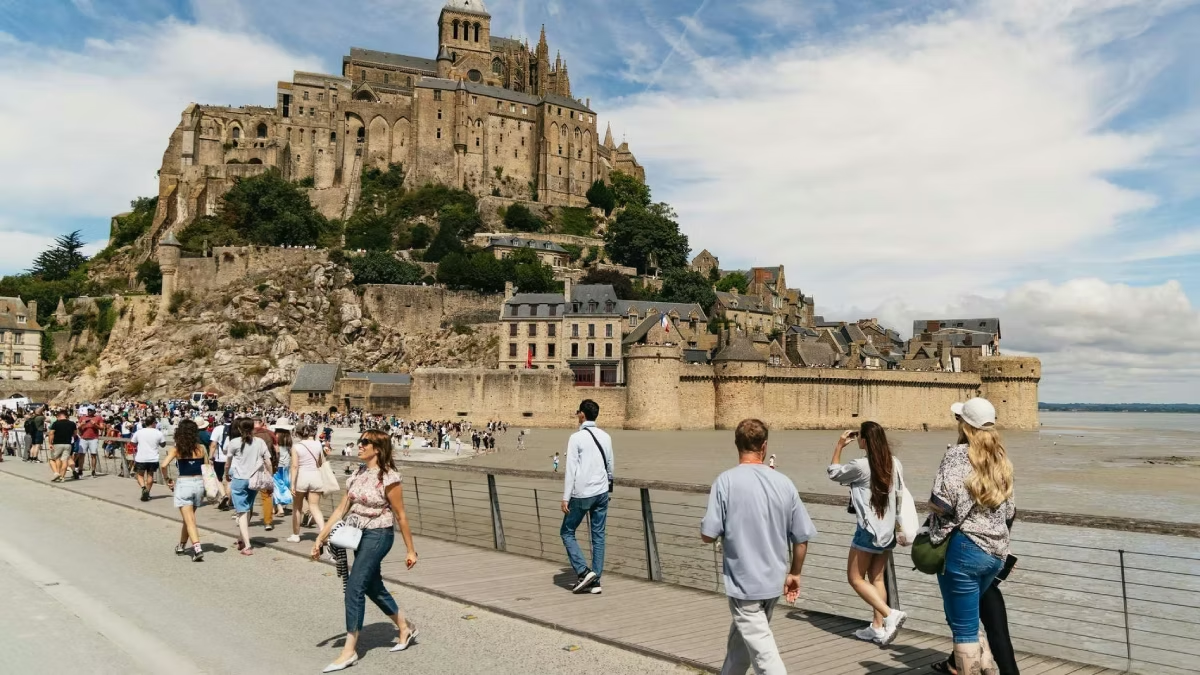
The visual impact is real and immediate: The approach to Mont-Saint-Michel — by road, by the causeway walk, or from any vantage point around the bay — is one of those sights that actually delivers on the photographs. The granite rock rising from the flat tidal bay, the medieval village clustered around it, the abbey pointing at the sky above — the scale and drama of the place are not diminished by familiarity with the image.
The abbey is a masterwork: La Merveille — the Gothic cloister, refectory, and Knights’ Hall built between 1211 and 1228 — is one of the great achievements of French medieval architecture. The cloisters in particular, suspended on the rooftop of the building above the sea, are as beautiful as anything in France. The abbey church, the crypts, and the west terrace together tell the story of 1,300 years of building, prayer, and siege. Visitors who go inside the abbey with some preparation — even just 20 minutes reading about what they will see — come away moved. Those who rush through in 40 minutes with no context leave less impressed.
The tides are genuinely dramatic: On high-coefficient days (the March and September equinox tides reach coefficients of 115–119 in 2026), the sea advances visibly across the bay at walking pace, surrounds the island completely, and the causeway goes under water. Watching the tidal bore — the audible wave front of the incoming tide — from the footbridge or ramparts is visceral in a way that photographs do not capture. No other major tourist site in France changes as dramatically and regularly as this one.
The island at night is extraordinary: After approximately 7pm, the day-trippers leave and the village empties. The illuminated abbey above empty cobblestone streets, the sound of the sea around the walls, and the solitude of the ramparts create an experience completely different from the midday visit. This is what overnight guests and evening visitors consistently cite as the thing they were not prepared for — the island without crowds is a different place.
The medieval village is the real thing: The Grande Rue is tourist-facing, but the buildings behind it and around it — approximately 60 listed historic structures — are genuinely 15th and 16th-century. The Church of Saint-Pierre, the hidden lanes, the Logis Tiphaine, the Venelle du Guet (55cm wide), and the village gardens are not reconstructed or reproduced. They are simply there, in use, in a medieval island that has been continuously inhabited for over 1,300 years.
The bay walk is unlike any other tourist activity: Walking across the bay floor with a certified guide — through quicksand, across tidal channels, with the island growing ahead of you — is something that has no equivalent at any other site. It is the experience that most separates visitors who came well-prepared from those who did not know it existed.
What Disappoints Unprepared Visitors
The crowd experience is genuinely bad if you arrive at the wrong time: In July and August, between 10am and 5pm, the island receives up to 20,000 visitors per day. The Grande Rue — the only route through the village to the abbey — becomes a slow shuffle in both directions. Navigation with bags or pushchairs is difficult. The restaurants are full. The abbey queue without advance tickets can be 45–90 minutes. If this is your experience of Mont-Saint-Michel, the site does not justify the journey.
The food is expensive and mostly mediocre: Restaurants on the island are priced for a captive tourist audience. The exception — La Mère Poulard — is a genuinely good experience but costs €60–€100 per person. For most visitors, the honest recommendation is to eat on the mainland and treat island food as a snack situation.
The on-island hotels are not comfortable by standard hotel measures: Medieval rooms, steep stairs, no lifts, no air conditioning in summer, cobblestone access routes. Visitors who expect hotel-standard comfort in a 14th-century building on a rocky island are disappointed. Visitors who know what they are getting — a genuinely extraordinary location that costs comfort — are not.
As a day trip from Paris, it is a long day for the experience it delivers at peak times: The journey takes 4–4.5 hours each way. A day trip from Paris in July, arriving at midday, leaves time for approximately 3 hours on the island in peak crowd conditions. This is not a good use of a day in France. If you are doing this as a day trip, go in May or September, aim to arrive early, and book your abbey ticket in advance.
Who Should Go
Go if:
- You have at least a half-day and can arrive before 10am or stay past 6pm
- You have an interest in medieval history, architecture, or the natural drama of tidal landscapes
- You are prepared to visit the abbey (booking in advance, allowing 90 minutes inside)
- You are visiting Normandy or Brittany and it is a natural stop rather than a dedicated pilgrimage from Paris
- You want one of the most distinctive natural and architectural spectacles in Western Europe
Consider skipping if:
- You are visiting Paris on a tight schedule and this would consume an entire day of your trip as a very long day trip in peak season
- You are travelling with very young children or people with significant mobility limitations and cannot access the abbey
- You have strong crowd aversion and cannot visit outside of peak hours — the midday summer experience is genuinely unpleasant
- You have already visited and are debating a return trip without a particular reason — the site changes little from year to year except for the Nocturnes programme
How to Make It Worth It: The Essential List
1. Time it correctly: Arrive before 10am or visit in late afternoon. May and September are the best months. This single decision determines more about your experience than any other factor.
2. Book the abbey in advance: The abbey is the reason this site exists. Visiting without going inside is like visiting Paris without seeing the Eiffel Tower. Buy your ticket before your visit — the price is the same and you skip the queue entirely.
3. Allow enough time: A good visit is 4–5 hours minimum. The abbey alone takes 90 minutes with any depth. Add the ramparts (45 minutes), the village (45 minutes), and time to simply exist in the place (important and often skipped).
4. Walk the causeway, at least one way: The pedestrian causeway from the car park to the island takes 40–50 minutes. Walking it — with the mount ahead growing gradually larger — gives a physical sense of the bay and the approach that the shuttle removes. Particularly rewarding at dawn.
5. If you are staying overnight nearby, visit in the evening: The island from 7pm is dramatically better than the island at 1pm. If you are staying in La Caserne or Pontorson, a second evening visit costs only the shuttle fare and changes your entire impression of the place.
6. Do the bay walk: If you have time for one thing beyond the abbey, a guided bay walk from the island (2km, 1.5–2 hours) is the most memorable activity at the site. Most visitors who do it say it was the highlight of their visit. See our bay walk guide for details.
The Verdict
Mont-Saint-Michel is worth visiting — but it is not worth visiting badly. Unlike some overhyped sites where the disappointment is structural (too built-up, too sanitised, the reality nowhere near the image), at Mont-Saint-Michel the problem is almost always one of execution: wrong time of day, no abbey ticket, no plan, no knowledge of what you are looking at.
Visited with preparation, at the right hour, with the abbey booked and time allowed — it is one of the great sites of France. The abbey is extraordinary. The tides are dramatic. The island at dusk is unforgettable. The bay walk is unique. The approach, from however far away, delivers on the image every time.
It requires more effort than most tourist sites. That effort is repaid.
Frequently Asked Questions
Is Mont-Saint-Michel worth it as a day trip from Paris?
Yes, if you travel in May or September, arrive early (before 10am), and book the abbey in advance. In July or August as a midday day trip with a coach group, the experience is significantly diminished by crowds.
Is the abbey worth visiting?
Yes — it is the defining experience of the site. Visiting the island without going inside the abbey is a significant missed opportunity. Book your ticket in advance.
How long do you need at Mont-Saint-Michel?
4–5 hours minimum for a meaningful visit covering the abbey, ramparts, and village. 6–7 hours for a full visit including a bay walk. One overnight allows the evening experience, which transforms the visit.
Is it worth visiting in winter?
Yes — particularly for photographers and visitors who want solitude. The crowds are minimal, the light is dramatic, and the site is open year-round. The abbey’s free admission on the first Sunday of November, December, January, February, and March is an added bonus.
Is it worth visiting twice?
For most visitors, once is sufficient unless there is a specific reason to return — the Nocturnes in summer, a particular spring tide event, or the desire to experience the island at a different season or time of day. The site changes little between visits except for the light, the tide, and the crowd level.
