
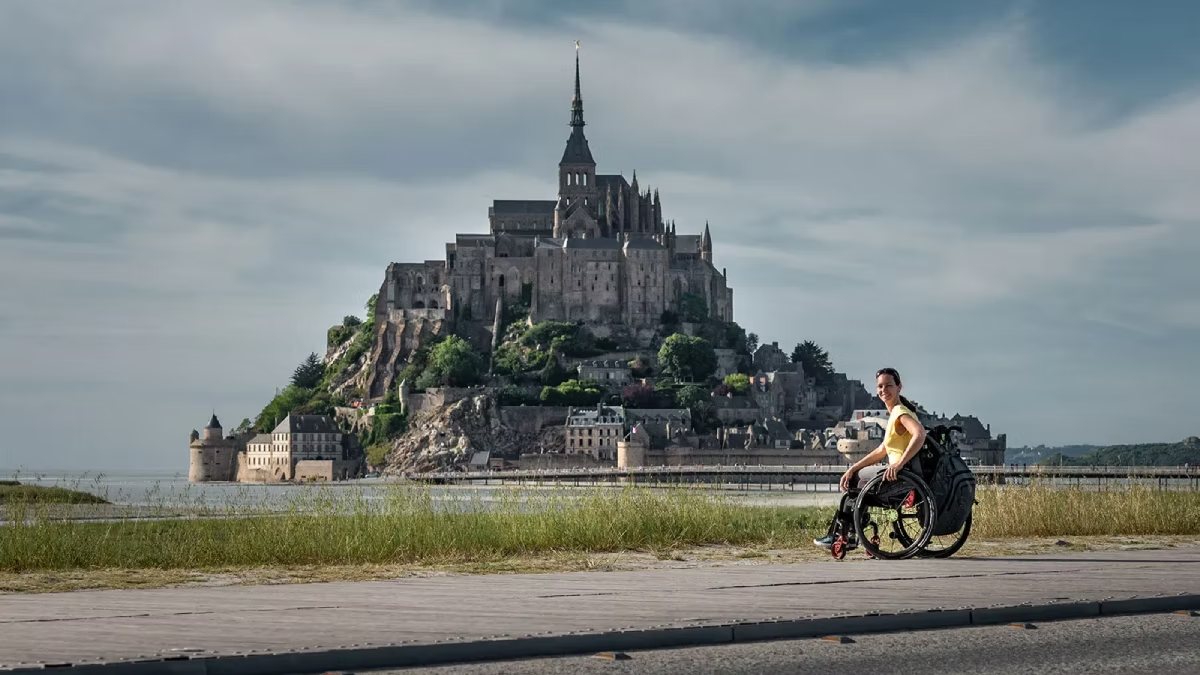
Mont-Saint-Michel Accessibility Guide 2026
Wheelchair Access, Ramps & Reduced Mobility Tips

Mont-Saint-Michel has significant accessibility limitations that must be understood before visiting. The abbey is not accessible by wheelchair — it requires climbing approximately 300 steps with no lifts or ramps. The village streets are steep cobblestones with gradients up to 20%. What is accessible: the car park (P2 is dedicated for disabled visitors), the Le Passeur shuttle (priority boarding, ramps, two wheelchair spaces), the lower village and Grande Rue as far as mobility allows, the Church of Saint-Pierre, some rampart sections, and the bay footpath from the car park. Free admission for disabled visitors and one companion. A Joëlette (one-wheeled carried chair) can be reserved for the abbey with at least 6 weeks’ notice.
This guide is written to give visitors with disabilities a frank, detailed picture of what to expect — not a reassuring but misleading overview. The site is extraordinary. The physical access challenges are real. Understanding both allows visitors to plan a visit that is meaningful and achievable.
Admission for Disabled Visitors
Abbey entry is free for visitors with a disability and one companion, on presentation of a valid disability card:
- French residents: “Disability” or “Priority” Mobility and Inclusion Card (CMI) issued by CDAPH
- Foreign visitors: the equivalent national disability card or permit
The parking card alone does not entitle the holder to free abbey entry — you must present your disability card at the abbey entrance.
Getting There: Parking
Car park P2 is the dedicated accessible parking zone. It is the closest car park to the shuttle stop and the Tourist Information Centre. To enter P2:
- Drive to the barrier and use the intercom — it connects automatically to the parking office
- Show a disability card (CMI or equivalent)
- No advance reservation is required, but availability is not guaranteed on peak days — arrive early
P2 has approximately 45 spaces. If it is full, other car parks (P5–P13) are available for light vehicles, but they are further from the shuttle and have less accessible surfaces.
Parking fees apply as standard; disability card holders do not receive a reduced parking rate — only the abbey entry is free.
The Shuttle: Le Passeur
The Le Passeur shuttle is one of the most accessible parts of the visit. It has manual ramps (maximum 300 kg), two dedicated wheelchair spaces, six priority seats, audio and visual announcements, and priority boarding for disability card holders.
- Ramp access: Manual ramps (maximum 300 kg) are deployed by drivers or platform staff at boarding and alighting
- Priority boarding: Show your disability card at the shuttle stop for priority boarding ahead of the general queue
- Dedicated spaces: Two wheelchair spaces and six priority seats per shuttle
- Audio and visual announcements inside the vehicle
- Drop-off: The shuttle stops approximately 350 metres from the island entrance gate — the distance from shuttle drop-off to the King’s Gate is flat and paved
The shuttle runs from 7:30am to midnight daily. The Tourist Information Centre adjacent to the shuttle stop also lends wheelchairs free of charge — contact them in advance at +33 (0)2 14 13 20 15 or [email protected].
From the Shuttle to the Island: The 350-Metre Approach
After the shuttle drops you at the footbridge terminus, a flat paved walkway leads approximately 350 metres to the island entrance gate (the King’s Gate). This section is accessible for most mobility equipment. The footbridge surface is even and suitable for wheelchairs.
Inside the Village: A Realistic Assessment
Once through the King’s Gate, the physical environment changes significantly.
The Grande Rue (Main Street)
The primary route from the island gate to the abbey. It is paved with irregular cobblestones, progressively steepens to approximately 20% gradient in upper sections, and has no handrails on the main street. In peak season it is crowded, adding to the difficulty of navigation. Power wheelchair users may manage the lower sections; manual wheelchair users will find the gradient and cobblestones challenging. It becomes impractical before the abbey entrance staircase.
The Fanils Entrance (Alternative Route)
On the left side of the island, this quieter route leads via a covered walkway (Chemin de Ronde) towards the abbey. The gradient is approximately 13% and the surface is wider than the Grande Rue. There is a short staircase fitted with a handrail before the route narrows considerably. Some visitors with limited mobility find this route more manageable than the Grande Rue.
Accessible Areas Within the Village
- The lower sections of the Grande Rue (shops, cafés, the lower village)
- The Church of Saint-Pierre — ground level, accessible without stairs
- Some sections of the lower ramparts
- The village gardens (benches, level ground)
- Wheelchair-accessible toilet at the bottom of the Grande Rue (small grab bar). The Tourist Information Centre toilet outside the walls is better equipped.
Not accessible by wheelchair: The abbey itself, the upper ramparts, the upper village, and anything requiring the main staircase to the abbey (139 steps from the Grand Degré).
The Abbey: What Is and Is Not Accessible
The abbey is not wheelchair-accessible. The route from the village to the abbey entrance involves approximately 300 steps across multiple sections, with no lift, no ramp, and no alternative route. A Joëlette (one-wheeled carried chair) can be reserved at least 6 weeks in advance for visitors holding an Invalidity CMI or equivalent.
The abbey for visitors with limited mobility who can manage stairs slowly: The abbey’s official guidance acknowledges that visitors with reduced mobility who can climb stairs with assistance may access the site at their own pace. Seating is available throughout — wooden benches, stone seats, and cushion seats in window embrasures are positioned in most areas. Allow significantly more time than a standard visit.
The Joëlette
The abbey offers a Joëlette (a one-wheeled chair carried by trained porters) as a means of accessing the abbey for visitors who would otherwise be unable to reach it. This is an intense experience for both visitor and porters, given the steep gradients and many steps involved.
To request a Joëlette:
- Email [email protected] at least 6 weeks before your visit (the official CMN website says 4 weeks minimum; sources vary — 6 weeks is the safer figure)
- The request must come from a visitor holding the “Invalidité” (Invalidity) Mobility and Inclusion Card or equivalent disability level. It cannot be used with a priority or parking CMI.
- Approval depends on staff availability, crowd levels, and a safety assessment
- Testing the Joëlette before using it at Mont-Saint-Michel is strongly advisable if possible
Remote and Alternative Options
- Online guided tours (approximately €40) — virtual access to the abbey spaces
- Sensory workshops and nature walks in the bay — 1h15 to 2h30, designed for visitors with reduced mobility, including tactile elements, sounds, and guided storytelling
- Folding cane-seats and wheelchairs available to borrow for comfort during the village visit
For advance enquiries about adapted visits, contact the abbey directly through abbaye-mont-saint-michel.fr.
What a Meaningful Visit Looks Like Without Abbey Access
Even for wheelchair users who cannot enter the abbey, a visit to Mont-Saint-Michel offers a great deal:
From the Car Park Area
The view of the mount from the car park, the footbridge, and the causeway is one of the great sights of Normandy. On spring tide days with the water surrounding the island, this exterior view is extraordinary in its own right.
On the Island
The lower village, the Church of Saint-Pierre, the shops and cafés of the lower Grande Rue, and the views from the lower ramparts all form a meaningful experience of the medieval site. The atmosphere of the island — the sounds, smells, and scale of the place — is present from the moment you enter the gate.
The Bay Walk (With a Guide)
Guided walks across the tidal flats are available for visitors with mobility limitations. Some routes are accessible for visitors with mobility aids on the flatter sections of the bay. Contact the Tourist Information Centre for adapted bay walk options.
The Tidal Spectacle
On high-coefficient tide days, the incoming tide can be watched from the footbridge and the lower village perimeter — no steps required, and the spectacle is just as dramatic from ground level as from the ramparts.
Accommodation Accessibility
Hotels on the island itself are generally inaccessible for wheelchair users — steep stairs, cobblestones, and medieval layouts make them unsuitable. The best-equipped accessible hotel in the area is the Mercure Mont-Saint-Michel in the La Caserne hotel zone, which has wheelchair-accessible rooms and is adjacent to the shuttle route. Contact the hotel directly to confirm room specifications.
Practical Tips
Insider Tip
Arrive early. P2 has limited spaces and does not accept reservations. Peak summer weekends can see P2 fill by mid-morning. Contact the Tourist Information Centre before your visit at +33 (0)2 14 13 20 15 to confirm wheelchair loan availability and current conditions.
Download abbey tickets before arriving: Mobile signal at the abbey entrance is unreliable. If you hold a disability card entitling you to free entry, arrange this at the counter rather than online, as free-entry tickets may require in-person disability card presentation.
The bay can be walked at low tide (with a guide): The flat bay floor is accessible for many mobility types that struggle with steep terrain. A certified guide can plan a route suitable for your mobility level.
Weather and surfaces: The cobblestone surfaces become slippery when wet. Wet weather significantly increases the difficulty for visitors with reduced mobility. If possible, plan your visit for dry conditions.
Frequently Asked Questions
Is Mont-Saint-Michel abbey wheelchair accessible?
No. The abbey requires climbing approximately 300 steps with no lift or ramp. A Joëlette (carried chair) can be reserved at least 6 weeks in advance for visitors with an Invalidity CMI or equivalent. Email [email protected] to request.
Is the shuttle wheelchair accessible?
Yes — the Le Passeur shuttle has manual ramps, two wheelchair spaces, six priority seats, and priority boarding for disability card holders.
Is abbey entry free for disabled visitors?
Yes — free for one disabled visitor and one companion on presentation of a valid disability card (CMI or foreign equivalent). The parking card alone does not entitle free entry.
What can wheelchair users see at Mont-Saint-Michel?
The lower village, the Church of Saint-Pierre, some lower rampart sections, and the exterior of the mount and bay. The abbey interior is not accessible by wheelchair.
Is the car park accessible?
Yes — P2 is the dedicated accessible parking zone, closest to the shuttle stop. No reservation required; show your disability card at the intercom barrier.
