
The Village & Grande Rue of Mont-Saint-Michel: What to See (2026)
The Complete Village & Grande Rue Guide

The village of Mont-Saint-Michel is a compact medieval settlement of approximately 200 metres from the King’s Gate to the abbey steps, built along the Grande Rue — a single steep cobblestone street lined with 15th and 16th-century stone buildings. Around 60 of these buildings are listed historic monuments. Entry to the village is free and open 24 hours. The best time to explore is before 10am or after 6pm, when the day crowds are gone and the streets reveal their genuine medieval character. Beyond the Grande Rue itself, narrow side lanes, hidden gardens, the Church of Saint-Pierre, the Venelle du Guet (55cm wide — the island’s narrowest passage), and the Logis Tiphaine museum reward those who step off the main route.
Most visitors to Mont-Saint-Michel treat the Grande Rue as a corridor to the abbey — a gauntlet of souvenir shops to be navigated as quickly as possible. That is a missed opportunity. The village is extraordinary in its own right, and understanding what you are looking at transforms the walk from a queue to an experience.
From the three fortified gates at its base to the 139-step Grand Degré at its summit, the village rewards curiosity — hidden gardens, the island’s narrowest passage at just 55 centimetres wide, a 14th-century noble residence, and a parish church that has served this community for over five centuries.
The Three Fortified Gates
Before you set foot on the Grande Rue, you pass through three successive fortified gates — a defensive sequence designed to trap attackers in a series of courtyards where they could be picked off from above. Understanding this gives the entrance an entirely different feel.
Porte de l’Avancée (Gate of the Advance): The outermost gate, accessible to carts and pedestrians alike. It leads into a first courtyard where the former 16th-century Corps de Garde des Bourgeois stood — the guard post for the civilian militia who supplemented the garrison. Two English bombards (captured cannons from the Hundred Years’ War) sit near this entrance, a reminder that the island was never taken by the English despite a 30-year siege.
Porte du Boulevard: The second gate, leading into another courtyard with intentionally misaligned doorways — the staggered layout made it impossible for attackers to use battering rams in a straight line. Both doors date from the 16th century.
Porte du Roy (King’s Gate): The third and most formidable gate, protected by two towers — the Tour de l’Arcade and the Tour du Roi — and originally equipped with a drawbridge and portcullis. This is where the Grande Rue begins. The red door immediately to your left beyond the King’s Gate belongs to La Mère Poulard — the island’s most famous restaurant, open since 1888.
The Grande Rue
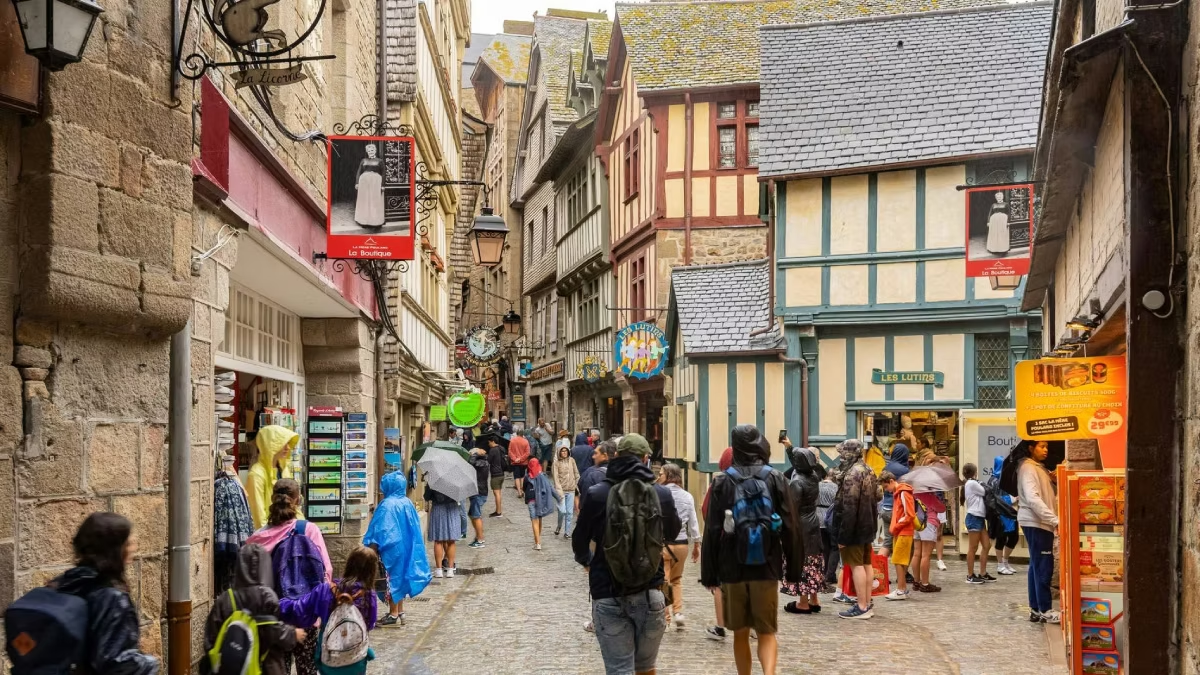
The Grande Rue is approximately 200 metres long. Without stopping, a steady walker covers it in around five minutes. That is not how it should be experienced.
The street was never designed for tourism. It was built for pilgrims, merchants, and monks — the commercial spine of a medieval island community that existed to serve the thousands of pilgrims making their way to the abbey above. The stone houses lining both sides date predominantly from the 15th and 16th centuries. Many still display old shop signs hanging from iron brackets — look up at the walls rather than at the shop windows.
By the 1960s, with mass tourism transforming the island, the houses were progressively converted into souvenir shops and restaurants. The street has been described, with some affection, as the most profitable shopping street in France per square metre. It is genuinely touristy. It is also genuinely medieval — and those two things coexist here more honestly than in most historic sites.
What to look for on the Grande Rue:
- The carved stone details above doorways — lintels, corbels, and decorative mouldings from the 15th century
- The varying widths of the street as it climbs — it narrows and steepens noticeably in the upper section
- The glimpses through doorways and archways to small courtyards and garden terraces beyond
- Old hanging shop signs on iron brackets protruding from stone walls
- The timber-framed façades of the medieval buildings — half-timbered construction visible on some upper storeys
At the top of the Grande Rue, the abbey staircase (the Grand Degré, 139 steps) leads to the abbey entrance. This is where the street ends and the visit to the abbey begins.
The Church of Saint-Pierre
Midway up the Grande Rue, easily missed in the rush for the abbey, stands the Church of Saint-Pierre — the island’s parish church, serving the small permanent community of residents and the monks and nuns of the abbey. Built in the 15th century and extended in the 16th, it is small, quiet, and free to enter.
Inside: medieval wooden statuary, stone carvings, a silver statue of Saint Michael that is carried in procession during special feast days, and an atmosphere entirely different from the abbey above — intimate and still used for its original purpose. Mass is held here regularly. Allow 15 minutes.
The small cemetery beside the church holds the graves of residents and, historically, of pilgrims who died on the island — a reminder that Mont-Saint-Michel was a living community before it was a tourist attraction.
The Logis Tiphaine
Just past the Church of Saint-Pierre stands the Logis Tiphaine — a 14th-century residence built by Bertrand du Guesclin, Constable of France and the greatest French military commander of the Hundred Years’ War, for his wife Tiphaine de Raguenel. Du Guesclin had it built here because Mont-Saint-Michel, which never fell to the English, was one of the safest places in France for a woman of rank during a period of sustained warfare.
The building has been converted into a small museum — one of four museums on the island — furnished with period furniture, armour, tapestries, and artefacts. Tiphaine herself was a notable figure: an astrologer and scholar whose library and instruments are represented in the museum. The astrology cabinet in particular is atmospheric. Entry approximately €9 (or combined with other island museums).
The Venelle du Guet
One of the island’s best-kept secrets: the Venelle du Guet (also known as the Ruelle des Cocus — the reason for that name is exactly what it sounds like) is the narrowest passage on Mont-Saint-Michel, measuring just 55 centimetres across at its tightest point. A person with broad shoulders or a large backpack cannot pass through.
To find it: on the Grande Rue, turn left in front of the Hôtel La Croix Blanche. It is easy to miss and that is the point — it is a hidden lane, not a marked attraction. The passage connects the main street to the rampart path on the other side. Exploring it gives a visceral sense of the medieval island’s compressed, vertical geography.
The Hidden Gardens and Side Lanes
Half of Mont-Saint-Michel’s interior area has always been free of buildings. During periods of siege, the islanders cultivated these protected terraces and gardens to sustain themselves. Today, some remain as garden plots (the monastic community still tends a vegetable garden at the foot of the abbey), and others are accessible from the side lanes that branch off the Grande Rue.
The village gardens — equipped with benches and set away from the main street — offer a quieter alternative to the Grande Rue bustle. They are visible from the ramparts above and accessible from several small passages east of the main street. On crowded summer days, they are almost always quiet.
The north face of the rock — steeper and wilder than the village side — remains largely in its natural state. The side passages and suspended staircases on the upper east and west flanks of the island offer views over rooftops and down to the bay that most visitors never see.
Timing: When to Visit the Village
Early morning (before 10am): The Grande Rue is empty. The shops have not yet opened. You can walk the full length in both directions without stopping for other people. The morning light falls along the street from the east. The abbey opens at 9am. This is the single best time to experience the village as a place rather than a crowd.
Midday (10am–5pm in summer): The peak crowd period. The narrow street becomes a slow-moving flow of visitors. Navigation with any kind of bag is difficult. The atmosphere is convivial but the medieval qualities of the place are harder to perceive.
Evening (after 6pm): From around 6pm the coaches leave and the village empties significantly. After 7pm in summer, the village has a completely different quality — quiet cobblestones, the illuminated abbey above, the sound of the sea. The village is open 24 hours and never closes.
Frequently Asked Questions
Is the village free to enter?
Yes — the village is a commune, freely accessible without a ticket or reservation, 24 hours a day. Only the abbey (€11 adults) and the museums (approximately €9 each) require tickets.
How long does the village take to explore?
Without the abbey: 45–90 minutes for a thorough exploration including the ramparts, church, and side lanes. With the abbey: add 90 minutes minimum.
What is the Venelle du Guet?
The narrowest street on the island — just 55cm wide. Found by turning left at the Hôtel La Croix Blanche on the Grande Rue.
Are the souvenir shops worth visiting?
A handful sell genuinely regional products — Norman ceramics, lace, sea salt from the bay marshes, local cider and calvados. Most sell generic tourist merchandise. The Mère Poulard biscuit shop near the entrance sells their famous shortbreads and biscuits, which make a good regional souvenir.
What is the Logis Tiphaine?
A 14th-century residence turned museum, built by Constable du Guesclin for his wife. Period furniture, armour, and an atmospheric recreation of a medieval noble household. One of four museums on the island.
