
Mont-Saint-Michel Abbey: Complete Visitor Guide
Room-by-Room Guide — What to See Inside the Abbey

The abbey is open 09:00–19:00 (May–August) and 09:30–18:00 (September–April). Entry is €11 for adults; free for all under 18 and EU citizens aged 18–25. Book in advance to skip walk-up queues. The visit covers three main areas: the abbey church, La Merveille (the Gothic masterwork housing the cloisters, refectory, and Knights’ Hall), and the crypts below. Allow a minimum of 90 minutes; 2 hours is comfortable; 2.5 hours with an audio guide or AR tablet. A free guided group tour is included with admission — approximately 45 minutes, in French or English.
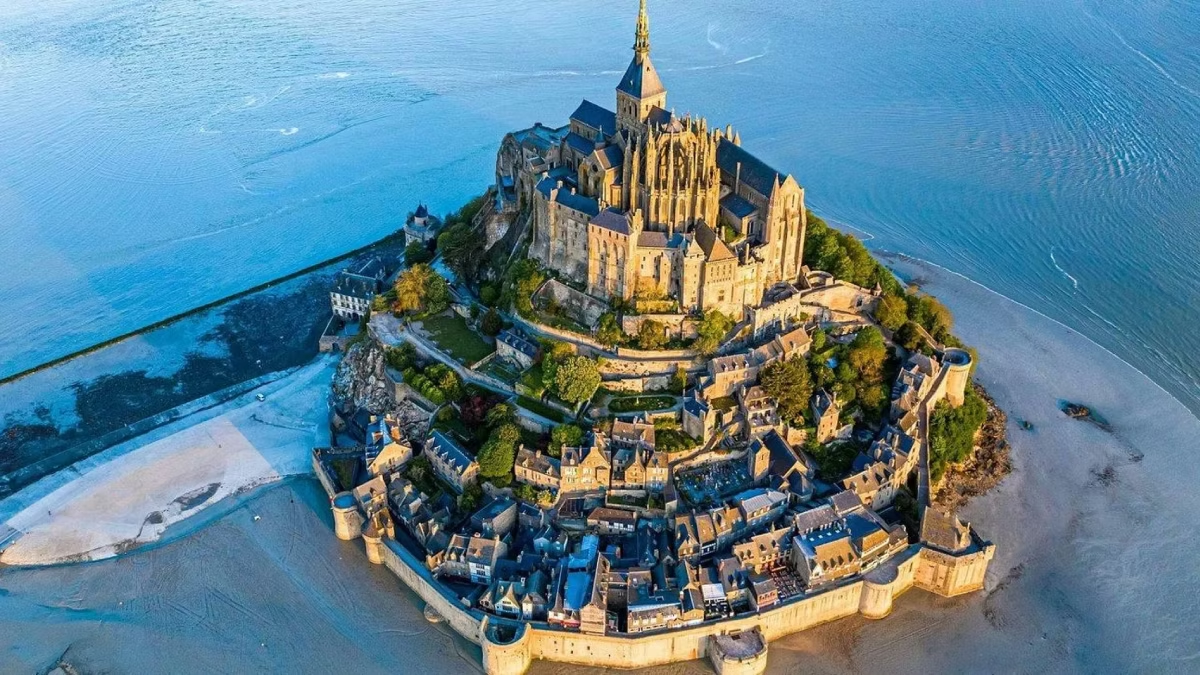
The Abbey of Mont-Saint-Michel is one of the great buildings of medieval Europe — not just beautiful, but structurally astonishing. It was built vertically up a granite rock, on foundations that shift and settle with the tides, by monks who had to solve architectural problems that had no precedent. The result is an abbey that functions simultaneously as a church, a monastery, a fortified stronghold, and a work of art. This guide takes you through it room by room.
The abbey covers over 1,300 years of construction. The architectural progression from Romanesque solidity to Gothic lightness is physically visible as you move through the spaces.
Essential Practical Information
Opening hours:
- May to August: 09:00–19:00 (last admission 18:00)
- September to April: 09:30–18:00 (last admission 17:00)
Closed: 1 January, 1 May, 25 December. Exceptional closures also occurred on 23 March and 1 June 2026 — always check the official CMN website before visiting.
Admission:
| Visitor Type | Price | Notes |
|---|---|---|
| Adults | €11 | Standard entry |
| EU citizens aged 18–25 | Free | Valid EU ID required |
| All visitors under 18 | Free | — |
| Disabled visitors + companion | Free | CMI card required |
| Jobseekers | Free | Certificate under 6 months + ID |
| First Sunday (Nov–Mar) | Free | Free for all visitors |
What is included: Full access to all publicly open rooms, the west terrace, and any temporary exhibitions. A multilingual information booklet in 12 languages. Free guided group tour (approximately 45 minutes, French and English daily; German, Spanish, Italian in July–August).
Audio guide: Available at the abbey entrance on your smartphone via a downloadable app. A small fee applies for the phone/data usage if needed — the guide itself is accessed through the app.
Revelacio AR tablet: Augmented reality experience (€5) available at the entrance, offering 3D reconstructions of the abbey’s medieval appearance overlaid on your live view. Includes a standard Discovery route and a Kids’ Quest route for families.
The History in Brief
The first oratory on the rock was built in 708 by Bishop Aubert of Avranches, who claimed the Archangel Michael appeared to him in a dream and instructed him to build a sanctuary. In 966, Benedictine monks established the first abbey, and construction of the major monastic complex began in earnest. The great abbey church was built from 1023 onwards. La Merveille — the Gothic masterwork on the north face of the rock — was built with extraordinary speed between 1211 and 1228. The Flamboyant Gothic choir was added in the 15th century. The abbey survived the Hundred Years’ War (it was never taken by the English), served as a prison during the Revolution and Napoleonic period, and was converted back to a monastery in 1966. A small community of monks and nuns still lives here today.
The abbey covers over 1,300 years of construction. The architectural progression from Romanesque solidity to Gothic lightness is physically visible as you move through the spaces.
Getting to the Abbey from the Island Gate
From the King’s Gate, follow the Grande Rue uphill for approximately 15–20 minutes (longer in summer crowds). The route passes through the village, past the Church of Saint-Pierre, through the abbatial gate, and up the Grand Degré — the main external staircase of 139 steps leading to the abbey entrance. This staircase is the steepest and most exposed section of the ascent.
An alternative route enters via the Fanils gate on the left side of the island — quieter, slightly wider, with a handrail on the initial staircase section.
Insider Tip
Show your pre-booked ticket QR code at the entrance. Download it before arriving — mobile signal at the entrance is unreliable.
Room-by-Room Guide
The West Terrace (Forecourt)
Before entering the abbey church, the west terrace offers the finest panoramic view of the visit: the open bay stretching to the horizon, the tidal flats or open water below depending on the tide, and the sweep of the Normandy coast. On spring tide days, this is the premier position for watching the incoming tide. The view from here inspired pilgrims for centuries — and still does.
This is the space to spend time on arrival, before the abbey interior absorbs your attention. On busy days, it is quieter here than inside.
The Abbey Church
The abbey church is the vertical centrepiece — the tallest element on the rock, rising to 155 metres at the tip of the spire. It is in two distinct architectural registers: the Romanesque nave (built from 1023, with its characteristic rounded arches and massive piers) and the Flamboyant Gothic choir (rebuilt after a partial collapse in 1421, luminous with its soaring pointed arches, large windows, and skeletal stone tracery).
The contrast between the severe solidity of the nave and the aerial lightness of the choir — built 400 years apart — is one of the great visual experiences in French architecture. The church is oriented east-west across the summit of the rock, which meant the architects had to build supporting crypts below the apse and choir to keep them level.
The abbey church still holds regular mass services. Check the abbey website for times during your visit.
La Merveille: The Gothic Wonder
La Merveille (The Marvel) is the 13th-century Gothic structure on the north face of the rock, built in just 17 years between 1211 and 1228. It is a three-level structure containing six main spaces, organised in two vertical columns (East and West) of three floors each.
The West side (bottom to top):
- The Almonry (Aumônerie): The lowest level — a vaulted storage space and the original hostelry for poorer pilgrims. Its simple Romanesque vaulting anchors the spectacular Gothic structures above.
- The Knights’ Hall (Salle des Chevaliers): The second level — the largest room in the abbey, four bays of Romanesque-transitional vaulting supported by massive columns. This was the monks’ scriptorium, where manuscripts were copied and illuminated. The sheer engineering scale of the space — held up not by solid rock below but by the almonry vaults — is remarkable.
- The Cloisters: The uppermost level of La Merveille — and the most celebrated space in the entire abbey. A double row of slender granite columns surrounds a rooftop garden, their arches carrying intricately carved foliage. The cloisters were built on the summit of the marvel, open to the sky, with the sea visible on three sides. The sense of suspension — beauty in the air above the tidal bay — is unlike anything else in French medieval architecture. Sit here for as long as you can.
The East side (bottom to top):
- The Cellar (Cellier): Heavy vaulted storage and service space.
- The Host Room (Salle des Hôtes): The reception room for noble and royal pilgrims — a graceful Gothic hall where kings of France were received. The ceiling vaulting is lighter and more ornate than the Knights’ Hall.
- The Refectory (Réfectoire): The monks’ dining hall — a masterwork of acoustic design. Narrow slit windows on the side walls flood the room with light while admitting almost no draught; the abbot’s reading desk was positioned so his voice would carry to every part of the hall during scripture readings at mealtimes. The room is long, calm, and deeply atmospheric.
The Crypts
Below the abbey church, four crypts support the weight of the structures above. These are the oldest surviving elements of the abbey and the most intimate spaces in the building.
Notre-Dame-sous-Terre: The original pre-Romanesque oratory on the rock, predating the abbey church above by centuries. A simple space of massive columns and rough stone — the seed from which the entire abbey grew. It is still occasionally used for prayer.
The Choir Crypt (Chapelle Saint-Martin): The barrel-vaulted crypt below the south transept, supported by enormous columns whose diameter reflects the extraordinary weight of the Gothic choir above.
The Crypt of the Major Archway: The structural spine of the rock, supporting the main nave above. The engineering is visible and fascinating — thick walls, heavy piers, and the logic of load-bearing stone.
The Gardens and Monks’ Walk
The terraced gardens on the south side of the abbey, and the monks’ walk (the cloister-level route around the exterior of the abbey), offer views across the village rooftops and the bay that few visitors access — they are less obviously signposted than the main route. The monks’ walk in particular gives a sense of the abbey’s perch above the rock and the medieval village below.
Guided Tours: Options
Free group guided tour: Included with your ticket. Approximately 45 minutes. In French or English, with additional languages (German, Spanish, Italian) in July and August. Registration on arrival or book online. The tour covers the main spaces with commentary from the abbey’s guides. A good introduction for first-time visitors.
Expert guided tour with access to closed rooms: A 2-hour in-depth tour by a Centre des Monuments Nationaux guide, with access to spaces not open on the standard route. Limited to 30 participants; advance online reservation required. An exceptional option for visitors with a deep interest in the history and architecture.
Practical Tips for the Abbey Visit
Go straight to the abbey on arrival: Do not stop on the Grande Rue on the way up. The abbey is at its best early in the morning before the crowds build. Arrive at opening, visit the abbey, then descend through the village on your way out.
Download your ticket QR code before leaving the car park: Signal at the abbey entrance is unreliable. A screenshot is the most reliable approach.
The audio guide is worth it: The abbey’s spaces have layers that are not immediately visible — the acoustic design of the refectory, the engineering decisions in the crypts, the symbolic orientation of the church. Commentary unlocks these. Allow an extra 30–60 minutes if using the audio guide.
Bring water: There is nowhere to buy water between the island gate and the abbey. The abbey is a long, physical climb in warm weather.
Wear comfortable, flat shoes: The Grand Degré staircase (139 steps), the internal abbey stairs, and the cobblestone village approach are all demanding in unsuitable footwear.
Book the free guided tour on arrival: Registration is on a first-come basis. In peak season, popular timeslots fill quickly — ask at the entrance immediately after arrival.
Frequently Asked Questions
How long does the abbey take to visit?
90 minutes minimum for the main spaces; 2 hours comfortably; 2.5–3 hours with audio guide or AR tablet and the free guided tour.
Is the audio guide included with the ticket?
The audio guide is an additional charge. It is accessed via a smartphone app — download it before arriving. The Revelacio AR tablet is €5 and available at the abbey entrance.
Can I attend a religious service at the abbey?
Yes — the community of monks and nuns holds regular services in the abbey church. The schedule is published on the abbey website. Visitors can attend respectfully.
What is La Merveille?
La Merveille is the 13th-century Gothic structure containing the cloisters, refectory, Knights’ Hall, and related spaces — considered the finest example of Gothic monastic architecture in France. The name means “The Marvel.”
Is the abbey accessible for visitors with reduced mobility?
The abbey involves approximately 300 steps and has no lifts or ramps. A Joëlette (carried chair) can be requested at least 6 weeks in advance. See the accessibility guide for details.
